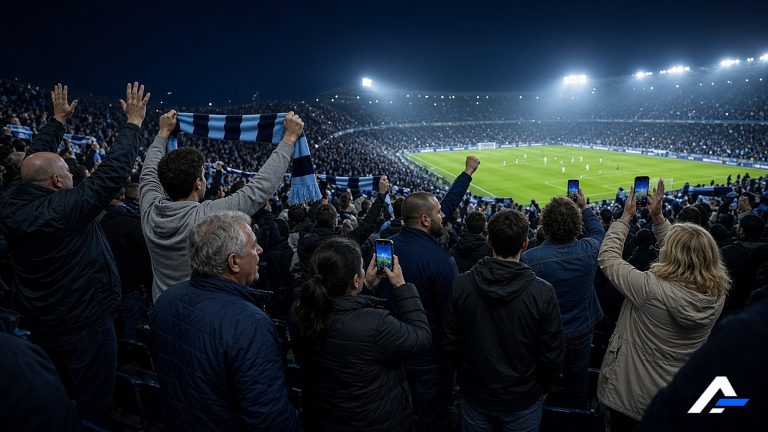

When RCD Mallorca travelled to Leganés at the weekend, the first team were not the only part of the club doing business in Madrid.
More than 100 businesspeople from Mallorca and the Spanish capital were brought together around the fixture through a joint initiative involving the RCD Mallorca Business Club and CD Leganés’ Club de Empresas.
The programme was straightforward: a visit to the Estadio Municipal Butarque, a working lunch bringing together companies from both business communities and, later, the match between Leganés and Mallorca.
What made the trip significant was not the format, but where it took Mallorca’s growing business network.
For the first time, relationships being developed around the club in Palma were being deliberately extended beyond the island.
It is an interesting next step for a project which only began last year.
RCD Mallorca officially launched its Business Club in September 2025 with the stated ambition of using football to connect companies from different sectors and create opportunities for collaboration. More than 200 executives and business leaders attended its inaugural event at Son Moix.
A year later, the club has moved into a second season with a programme of eight events and a greater emphasis on encouraging members to do business with one another rather than simply attend functions together.
The trip to Leganés is perhaps the clearest example yet of what that can mean in practice.
For a business community based on an island, the opportunity to establish relationships elsewhere in Spain has an obvious value. Mallorca can organise networking events at Son Moix — and does — but taking a group of businesses into another club’s commercial network creates connections that would be far more difficult to manufacture in isolation.
Football provides the introduction.
That is where clubs have an advantage which extends well beyond the traditional sponsorship proposition.
Companies may initially associate themselves with a football club for its audience, visibility or hospitality opportunities. But a club also sits at the centre of an unusually varied network of people and organisations: large companies, local businesses, institutions, supporters and decision-makers from dozens of different industries.
The question is how effectively it uses that network.
Mallorca appear increasingly interested in making it useful.
The club has strengthened its links with the Balearic business community through agreements with organisations including PIMEM, the federation representing small and medium-sized businesses, and CAEB, the Confederation of Business Associations of the Balearic Islands.
Its Business Club, meanwhile, is being developed around more than simply access to matches. This season’s programme covers subjects including leadership, artificial intelligence and technology, communication, marketing, innovation, sustainability and internationalisation.
That last area is particularly relevant to what happened in Madrid.
Aina Mesquida, who is responsible for the RCD Mallorca Business Club, said one of the objectives of the Leganés trip was to create relationships between companies outside Mallorca and give those connections the possibility of developing into genuine business opportunities.
The important part is that the exchange will not end at Butarque.
When Leganés travel to Mallorca for the return fixture at Son Moix, representatives of the Madrid club’s business community are expected to make the journey too.
That gives both groups another opportunity to meet and, more importantly, gives the relationships created in Madrid somewhere to go next.
There is a distinction between organising networking events and building a network.
Mallorca are attempting the latter.
For clubs looking to increase their commercial value, there is something worth studying in that approach.
Sponsorship will always involve visibility. Advertising inventory, hospitality and brand association remain valuable parts of the package.
But football clubs can offer something that conventional advertising platforms cannot: relationships.
The strongest commercial proposition may therefore be less about telling a company how many people will see its name and more about asking who the club can introduce it to.
For RCD Mallorca, a trip to Leganés involving 100 businesspeople may appear a relatively small initiative alongside everything that happens around a professional football club.
Commercially, it could be a sign of something much bigger.